
WEATHER FOLKLORE: Can Woolly Worms Really Predict The Upcoming Winter?

The Southern Tennessee Weather Blog is proudly presented by Heritage South Community Credit Union.
We Help When Others Won’t!
Visit https://www.heritagesouth.org/ today to see how HSCCU can help YOU!
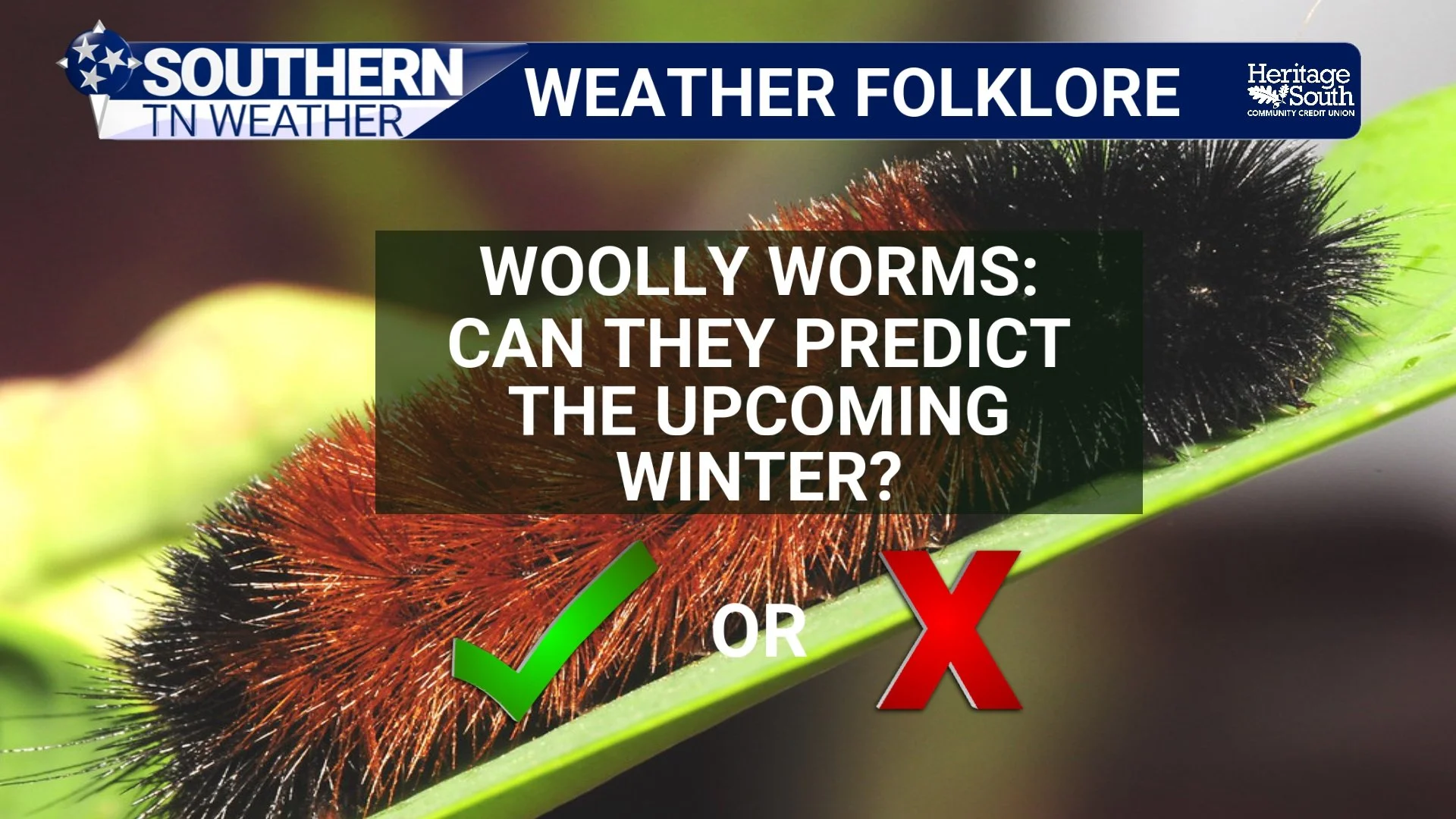
We’re bringing back our Weather Folklore series today, and this one may be about as Southern Appalachian as it gets. You’ve probably heard somebody say it before: Take a look at the woolly worm. It’ll tell you what kind of winter we’re going to have. According to the old saying, a woolly worm with lots of black means you’d better get ready for a long, cold, snowy winter. A wider brown stripe through the middle supposedly means winter will be on the milder side. Some versions of the folklore get even more specific, claiming the location of those black bands can tell you when the worst part of winter will arrive.
That’s a pretty impressive forecast coming from a fuzzy caterpillar crawling across your driveway. But can a woolly worm actually give us a sneak peek at December, January and February? Well... you probably already know where this is going. 😂
First... Woolly Worm Or Woolly Bear?
Both! The caterpillar we’re talking about is the banded woolly bear, scientifically known as Pyrrharctia isabella. Across the southern United States, though, you’ll frequently hear it called a woolly worm. Eventually, that fuzzy little caterpillar turns into an Isabella tiger moth. They’re easy to recognize. The classic woolly worm has black hairs on both ends with a rusty brown or reddish-orange band through the middle.
And as we head deeper into fall, you’ll probably start seeing quite a few of them crawling across roads, sidewalks and driveways. They aren’t crossing the road because they’ve received an updated winter outlook from the Climate Prediction Center. They’re looking for a protected place beneath leaves, bark, rocks or fallen logs where they can spend the winter.
So... How Do You “Read” A Woolly Worm?
This is where the folklore gets fun. Traditionally, more black supposedly means a harsher winter, while a wider reddish-brown middle section supposedly means a milder winter. And apparently our little meteorological caterpillar can provide more than a seasonal outlook.
According to another version of the folklore, the woolly worm’s body has 13 segments representing the roughly 13 weeks of winter. Darker sections supposedly correspond to colder or snowier periods. If the front of the caterpillar is especially black, winter is supposed to start rough. If the back is darker, Old Man Winter supposedly saves his worst for later. There are even versions claiming that a woolly worm crawling south means it knows a rough winter is coming and is trying to escape, while one crawling north supposedly predicts a mild winter.
At that point, we’re asking quite a lot from a caterpillar.
Where Did This Folklore Come From?
The belief itself goes back a long way, but its popularity received a major boost in 1948. That year, Dr. C. H. Curran, an entomologist and curator at the American Museum of Natural History, traveled to Bear Mountain in New York and examined woolly bear caterpillars. The National Weather Service says Curran examined just 15 specimens during that initial outing and used their brown bands to make a winter prediction. A reporter with the New York Herald Tribune covered the story, it was picked up nationally, and suddenly the woolly worm had itself a forecasting career.
The idea became so popular that communities eventually began holding woolly worm festivals. One of the best-known is just a few hours east of us in Banner Elk, North Carolina, where woolly worms have even been raced to determine which lucky caterpillar gets the honor of issuing the official winter forecast. Forget the European model. We’ve got Gerald the Caterpillar.
But What Do Those Colors Actually Tell Us?
Here’s where the real science comes in. The width of a woolly worm’s brown and black bands does change, but those changes don’t appear to tell us anything useful about the winter ahead. Instead, scientists have found that coloration can be influenced by the caterpillar’s age, growth, genetics, species and conditions it has already experienced. As banded woolly bears grow and molt, they generally become less black and develop more of that reddish-orange coloration.
The Missouri Department of Conservation also notes that weather during the caterpillar’s past growing season can influence its coloration. In other words, there can actually be a connection between woolly worms and weather—but they’re giving us information about conditions that have already happened, not sending us a forecast several months into the future. That’s an important distinction.
A caterpillar crawling around Southern Middle Tennessee in September has no way of knowing whether a storm system will track from Memphis to Nashville on January 15th, whether Arctic air will be sitting over Tennessee when it arrives, or whether that storm will bring us 6 inches of snow or 42-degree rain. And unfortunately for all of us snow lovers, those are the kinds of ingredients that actually determine whether we have a snowy winter.
There’s Another Problem...
Not every fuzzy caterpillar you see is even the right woolly worm. North America has numerous species of tiger moths and other fuzzy caterpillars with dramatically different colors. Some may appear nearly all black, while others can be much lighter.
So if we’re already trying to forecast an entire winter by measuring stripes on one caterpillar, accidentally grabbing the wrong species isn’t exactly going to improve our verification statistics. The National Weather Service specifically notes that some of the different colors people attribute to winter forecasting are simply the normal appearance of entirely different species.
What Woolly Worms Are Really Good At
They may not be great meteorologists, but woolly worms are surprisingly impressive when it comes to actually surviving winter. The banded woolly bear spends the cold season as a caterpillar. As winter approaches, it finds a protected location and enters a dormant state. Its body produces compounds that function somewhat like natural antifreeze, helping protect its cells as temperatures fall. Then, when warmer weather returns in spring, the caterpillar becomes active again, eventually forms a cocoon and emerges as an Isabella tiger moth.
So maybe we’ve been asking the wrong question all along. The woolly worm may not be able to tell us how cold winter will be... but it’s certainly better prepared for it than most of us are.
THE STN WEATHER VERDICT
Scientific Rating: ❌ Mostly Myth! There is no reliable scientific evidence that the width or placement of a woolly worm’s black and brown bands can predict the severity of the upcoming winter. Its appearance is influenced much more by its age, development, genetics, species and conditions during the season it has already experienced. But just like counting August fogs, cracking open persimmon seeds or watching squirrels gather nuts, I’m certainly not campaigning to get rid of the tradition.
Weather folklore is fun, and it gives us a glimpse into how generations before Doppler radar, satellites and computer models tried to find patterns in the natural world around them. So when the woolly worms start crossing Southern Middle Tennessee roads this fall, send me some pictures. We may even have to conduct a highly scientific STN Weather Woolly Worm Winter Outlook. Just understand that when January rolls around, I’ll probably trust the weather models a little more than the caterpillar. 😂
🌡️⛈️ NOW... THE ACTUAL FORECAST
Before we worry about woolly worms and snow, Mother Nature would apparently like to remind us that it is still very much August in Tennessee. Dangerous heat continues this afternoon, with temperatures in the mid to upper 90s and heat index values around 105–110° in many communities. A Heat Advisory remains in effect, so continue taking the heat seriously if you’re working or spending much time outdoors. We’re also watching a weak cold front dropping south through the region this afternoon and evening. Scattered showers and thunderstorms are expected to develop, with the greatest coverage generally along and east of Interstate 65.
The main window for stronger storms will be roughly 3–8 PM, although some activity may develop a little earlier across our southern counties. A few storms could produce damaging straight-line wind gusts, along with torrential rainfall and frequent cloud-to-ground lightning. The highest severe-weather potential remains across our eastern counties and closer to the Cumberland Plateau.
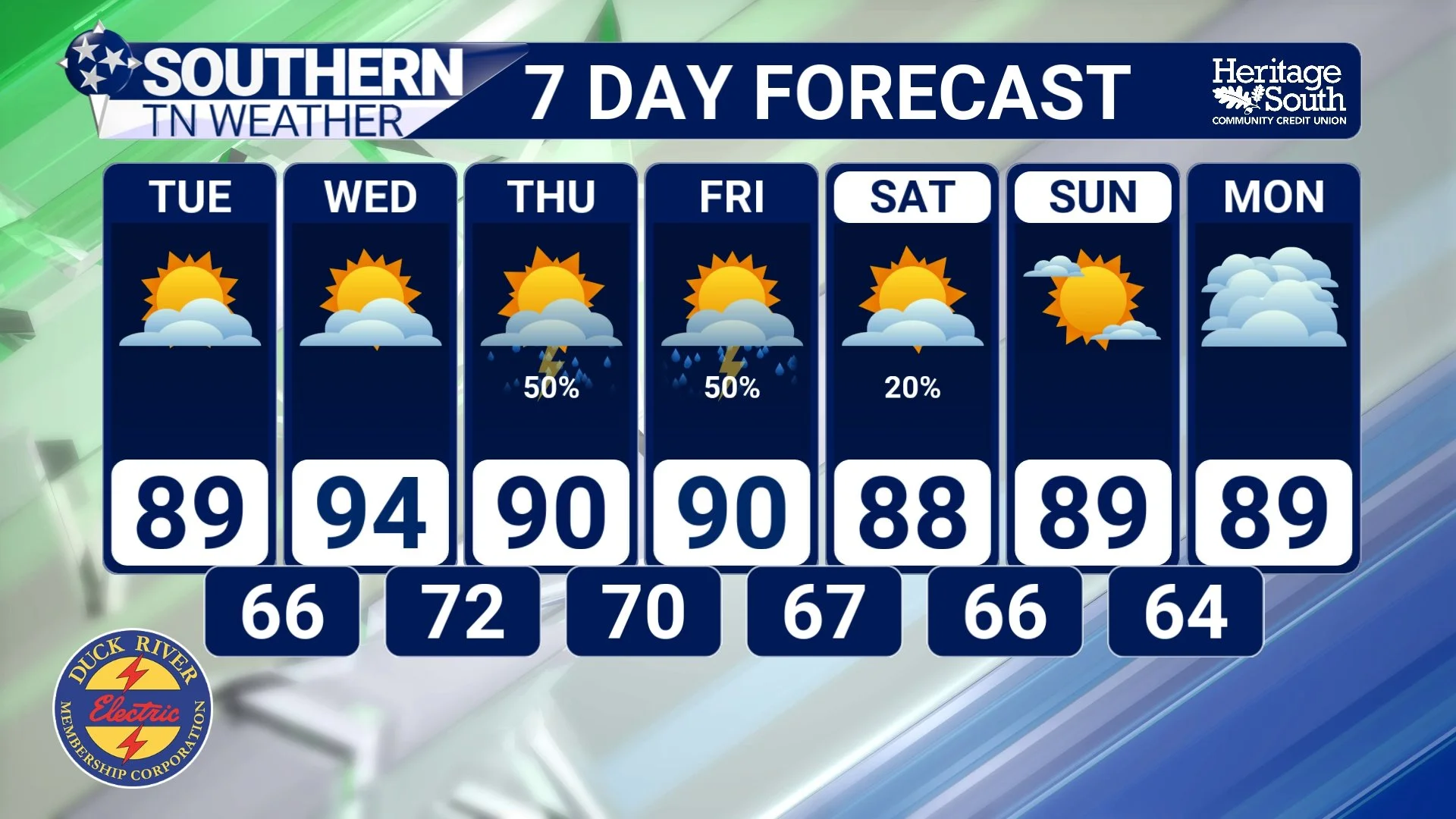
The good news comes Tuesday. Behind the front, slightly cooler and noticeably drier air filters into Southern Middle Tennessee. Highs generally fall back into the upper 80s and lower 90s, while dew points drop into the 60s. It certainly won’t be chilly, but after the swamp we’ve lived in lately, you’ll probably notice the difference. Unfortunately, summer has one more comeback attempt planned for Wednesday. Temperatures and humidity climb again, with highs returning to the lower and middle 90s before another weather system approaches.
That next system should bring another round of scattered showers and thunderstorms Wednesday night into Thursday. There could be enough instability for a few stronger storms, so we’ll keep an eye on that potential as we get closer. After that? Things actually look pretty nice by August standards. A larger trough developing over the eastern United States should help push another front through the region late in the week. Current guidance favors near-normal temperatures, lower humidity and relatively small rain chances heading into the upcoming weekend.
So we’ve got dangerous heat, strong storms, a cold front, another burst of heat, another round of storms, and then cooler weather... Meanwhile, somewhere out there, a woolly worm is probably wondering why we make this so complicated. 🐛😂
The Bottom Line 🧾
Woolly worms cannot reliably predict the upcoming winter. The size and placement of their black and brown bands are influenced by age, growth, genetics, species and conditions they’ve already experienced.
The folklore says more black = a harsher winter and more brown = a milder winter, but there’s no proven scientific relationship between those colors and the winter ahead.
Today’s actual weather concern is dangerous heat, with heat index values around 105–110° and a Heat Advisory in effect.
A few storms could become strong this afternoon and evening, especially along and east of Interstate 65, with damaging wind gusts the main concern.
Tuesday brings a brief break from the worst heat and humidity before temperatures climb again Wednesday. Another round of storms is possible Wednesday night into Thursday, followed by more comfortable weather heading into the weekend.
📰 Reminder: The Southern Tennessee Weather Blog, presented by Heritage South Community Credit Union, is updated Monday through Friday with fresh, locally tailored forecasts you can trust.
