
Move over Heat Index, WBGT is coming to town!

The Southern Tennessee Weather Blog is proudly presented by Heritage South Community Credit Union.
We Help When Others Won’t!
Visit https://www.heritagesouth.org/ today to see how HSCCU can help YOU!
We’ve spent a LOT of time talking about the Heat Index this week—and for good reason. When the thermometer is pushing the upper 90s and the humidity is thick enough to wear, knowing how hot it actually feels to your body becomes pretty important. But there’s another heat measurement you may start hearing more about, especially if you have kids playing sports, work outside, coach athletics, exercise outdoors or simply spend a lot of time in the summer sun.
It’s called Wet Bulb Globe Temperature, or WBGT. And before you ask: no, this isn’t the same thing as the “wet-bulb temperature” you may have heard about online. WBGT is its own measurement, and although the name sounds like something only a meteorologist could love, the idea behind it is actually pretty simple.
WBGT attempts to answer a more practical question: How stressful are these outdoor conditions on someone who is physically active in the heat? That becomes especially relevant this weekend as Southern Middle Tennessee heads into the hottest portion of our ongoing heat wave.
First, What Exactly Is WBGT?
The Heat Index most of us are familiar with primarily uses air temperature and humidity to estimate how hot conditions feel to the human body. Importantly, the familiar Heat Index is calculated assuming shady, light-wind conditions. Full sunshine can make conditions substantially more stressful than that number alone suggests. WBGT takes the idea several steps further.
For outdoor conditions, Wet Bulb Globe Temperature accounts for air temperature, humidity, wind and radiant heat from the sun. National Weather Service forecast products also account for factors such as sun angle and cloud cover when estimating it. In other words, WBGT is trying to capture more of the environment your body is actually experiencing when you're standing, working, practicing or exercising outside. Think about two 95° afternoons. On the first afternoon, you're standing under an overcast sky with a decent breeze. On the second, you're standing on a football practice field under blazing August sunshine with barely a breath of wind.
The thermometer could read 95° on both days. The humidity could even be similar. But those two environments can place very different amounts of heat stress on your body. That's exactly the kind of difference WBGT is designed to help identify.
Why Is It Called “Wet Bulb Globe Temperature?”
This is where we get slightly nerdy—but stick with me. A traditional WBGT instrument uses three different temperature measurements. The dry-bulb temperature is basically the regular air temperature we're all familiar with.
The natural wet-bulb temperature helps account for humidity and the potential for evaporative cooling. That's important because sweating is one of our body's primary methods of getting rid of excess heat. When the atmosphere is very humid, sweat doesn't evaporate as efficiently. Then there's the strange-looking one: the black globe thermometer. It's designed to measure radiant heat—including the energy you're absorbing from sunshine. OSHA describes WBGT instruments as using these three measurements to assess the thermal environment around a worker.
For outdoor environments with sunshine, the basic calculation gives the natural wet-bulb temperature the greatest weight: WBGT = 70% wet bulb + 20% globe temperature + 10% air temperature. Don't worry, there will NOT be a test at the end. 😂
The important part is what those measurements represent. Instead of looking only at temperature and humidity, we're bringing moisture, evaporation, sunshine, radiant heating and air movement into the picture.
So Why Isn't WBGT 110° When the Heat Index Is 110°?
This is probably the most important thing to understand if WBGT becomes more familiar to the general public. You cannot compare the numerical value of WBGT directly with the Heat Index. If the Heat Index is 108° and the WBGT is 90°, that does NOT mean WBGT is saying it “really feels like” only 90°. They're two different measurements with two different purposes and two different scales.
The National Weather Service gives a great example. With an air temperature of 100°, a dew point of 70°, mostly sunny skies and a 5 MPH wind, its example produces a Heat Index of 108° but a WBGT of 94°. Increase the wind to 13 MPH and the WBGT falls to 90°, while the Heat Index remains 108°.
Why? Because wind matters to WBGT. So does sunshine. So do clouds. That's one of its biggest advantages when we're talking about people actually doing something outside.
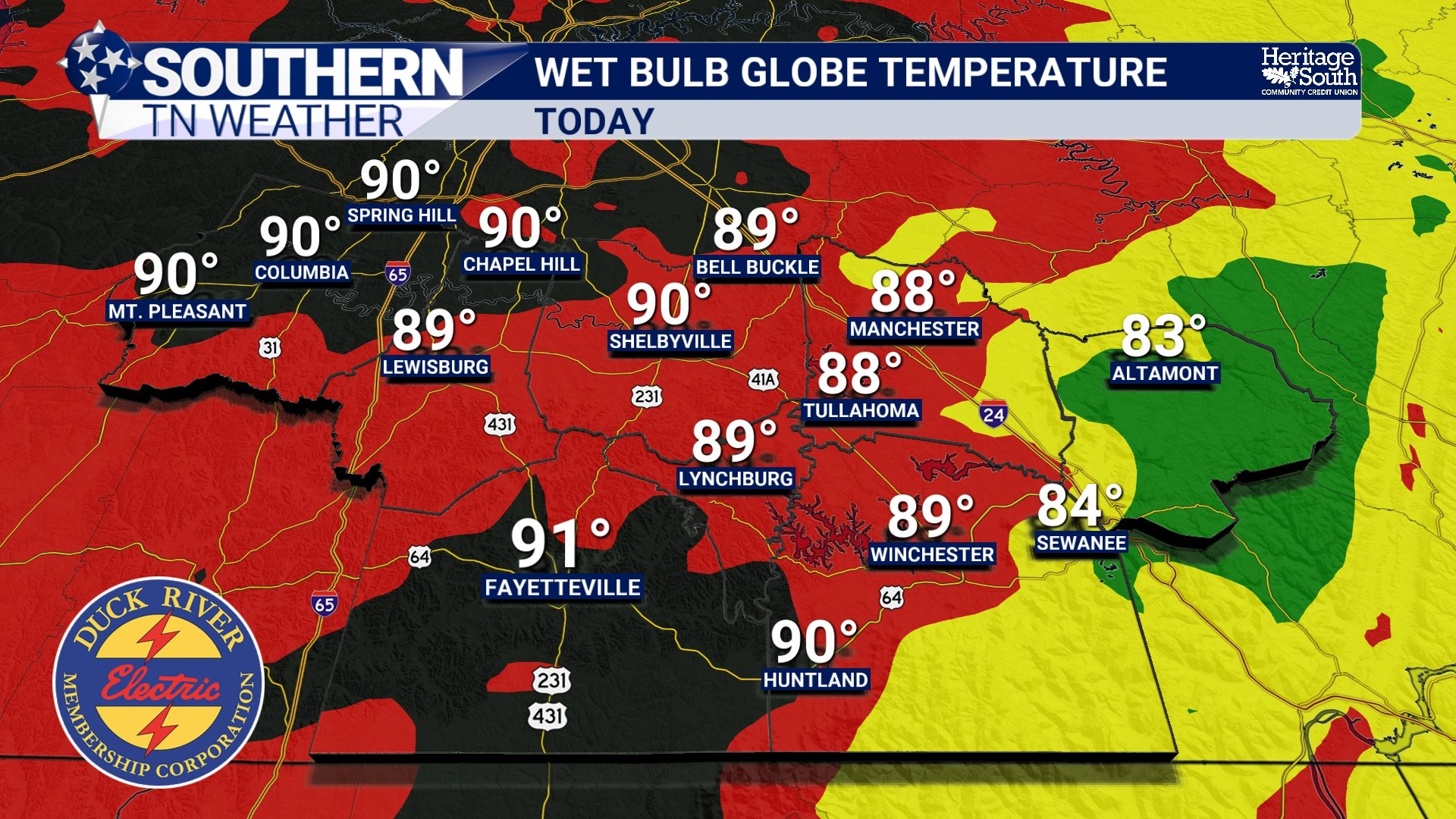
WBGT - TODAY
WBGT Isn't Actually New
Here's another interesting part: despite WBGT suddenly receiving more attention, the concept has been around for roughly 70 years. Its origins trace back to the 1950s and concerns over heat illness among military recruits training in hot, humid conditions at the Marine Corps Recruit Depot at Parris Island, South Carolina. Military and medical researchers needed a better way to determine when environmental conditions were becoming dangerous for strenuous physical activity.
Today, WBGT is used or recommended by organizations including the military, OSHA and numerous athletic organizations. The National Weather Service notes that it's particularly useful for active populations such as outdoor workers and athletes. So WBGT isn't some brand-new weather index somebody cooked up last Tuesday. What's changing is how much attention it's receiving outside the groups that have used it for decades.
Is WBGT Going to Replace the Heat Index?
Probably not in the sense that you'll suddenly never hear “Heat Index” again. The two measurements can serve different purposes. For communicating generally how hot and humid an afternoon will feel, the Heat Index remains extremely useful and familiar. If I tell you tomorrow's Heat Index could reach 110°, most people immediately understand that it's going to be dangerously hot.
WBGT becomes especially valuable when we're asking questions such as: Should football practice be modified? How frequently should outdoor workers take breaks? Is it safe to run several miles this afternoon? How much heat stress will someone performing strenuous activity in direct sunlight experience?
That's why you'll often see WBGT paired with recommendations for adjusting activity levels, adding rest periods, increasing hydration and moving strenuous activity to a different part of the day. Exact thresholds and recommendations can vary based on geography, acclimatization, workload and organizational guidelines, so a WBGT number shouldn't be interpreted as one universal “safe versus dangerous” cutoff for everybody.
In short, think of it this way: Heat Index tells us a lot about how hot and humid it feels. WBGT gives us additional information about how stressful the outdoor environment can be for physical activity. And during a Southern Tennessee August, both can be pretty useful numbers to know.
Speaking of Heat... This Weekend Is Going to Be BRUTAL 🥵
Unfortunately, today's WBGT lesson comes at a very appropriate time. A strengthening ridge of high pressure remains firmly in control across the Southeast, and we're heading into what should be the hottest portion of this heat wave over the weekend. An EXTREME HEAT WARNING is now in effect for much of Middle Tennessee west of the Cumberland Plateau through Sunday, while Heat Advisories cover surrounding areas. Across the Huntsville forecast area, including Lincoln, Moore and Franklin counties in Southern Middle Tennessee, a Heat Advisory has been extended through Monday.
This afternoon, highs will generally reach the middle to upper 90s, with Heat Index values ranging from roughly 105–112° in the hottest locations. An isolated shower or thunderstorm remains possible this afternoon, especially along and east of Interstate 65, but most communities won't receive meaningful rain-cooled relief. And then we turn the furnace up another notch.
Saturday & Sunday: Peak of the Heat Wave
Saturday and Sunday continue to look like the hottest days of this stretch. Actual air temperatures will climb into the upper 90s across the vast majority of Southern Middle Tennessee, and some communities could reach or exceed 100°. Factor in the humidity and afternoon Heat Index values will commonly reach 105–110°, with some locations potentially exceeding 110°. Rain chances are also essentially nonexistent for most of us this weekend. Strong high pressure overhead will suppress most shower and thunderstorm development, which means we lose one of the few things that can occasionally provide a temporary summertime cooldown.
The other problem is what happens (or rather, what doesn't happen) after sunset. Overnight lows will generally remain in the middle and upper 70s. When nighttime temperatures remain that warm, homes without adequate air conditioning and people spending extended periods outdoors don't get much opportunity to recover before temperatures begin climbing again the following morning. That's one reason the National Weather Service is highlighting a Major to Extreme HeatRisk through the weekend. And remember what we just spent this entire blog discussing: the thermometer and Heat Index don't tell the entire story for someone working or exercising in direct sunshine. Sunshine, limited wind and physical exertion can add substantially to the heat stress your body experiences.
If you've got football practice, yard work, construction work, a long run, a festival, sports or anything else outside this weekend, this is exactly the kind of situation where WBGT can provide useful additional information.
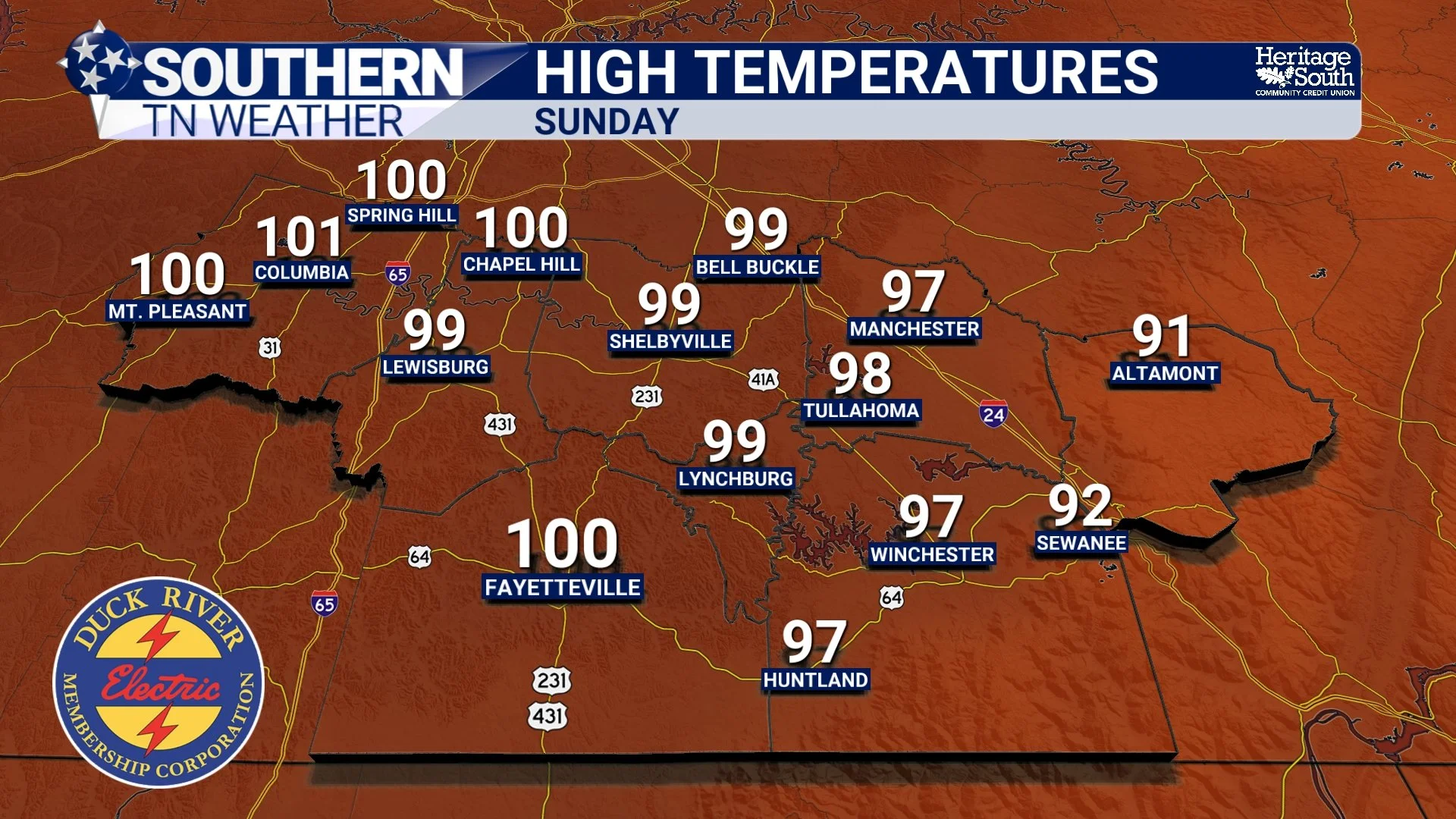
HIGH TEMPS - SUNDAY
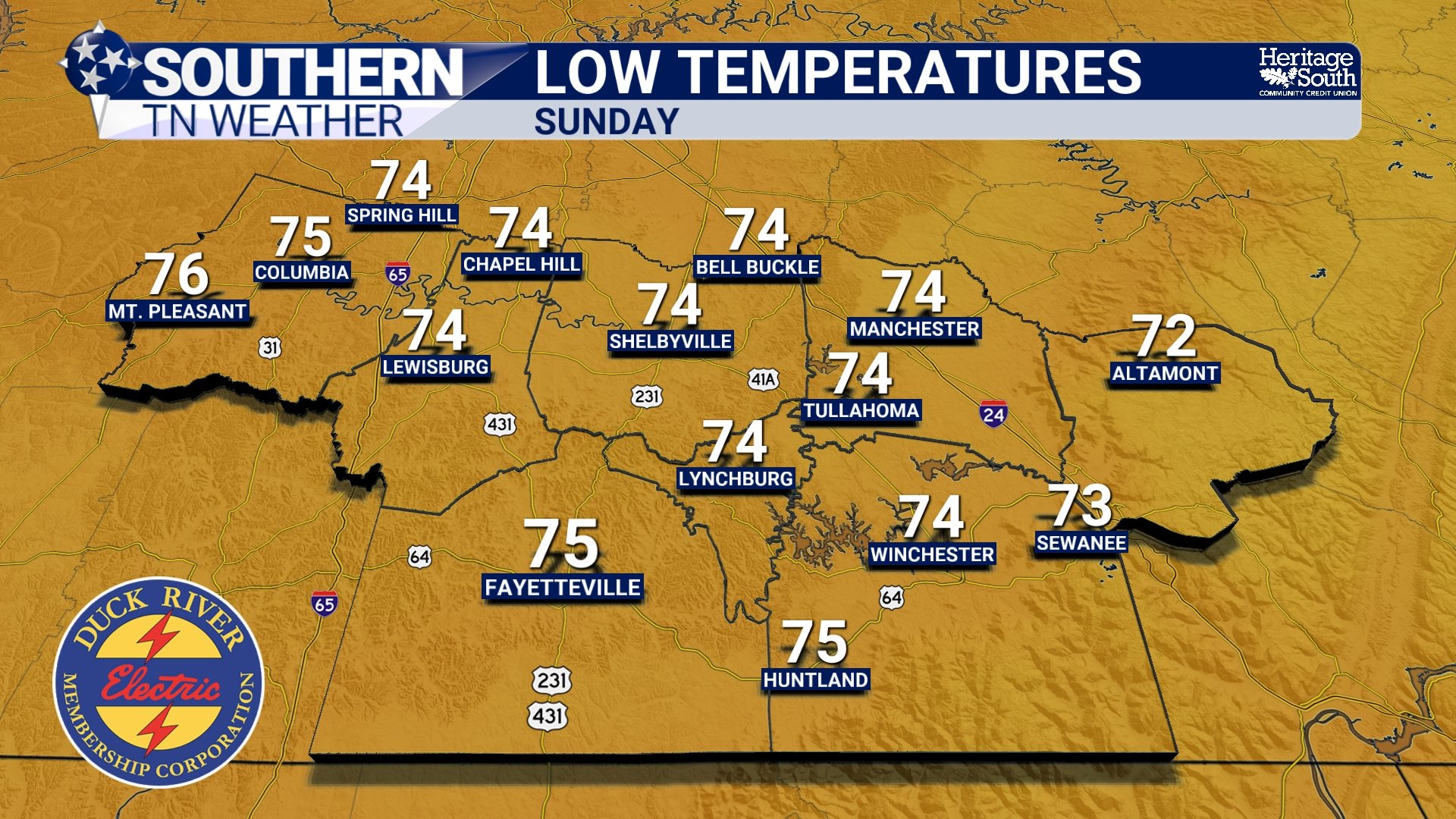
LOW TEMPS - SUNDAY
What About Next Week?
There are at least some signs of minor relief as we head into early next week—but don't start digging out the hoodies. The upper-level ridge responsible for this heat should gradually shift westward, potentially allowing temperatures to back off a few degrees. Monday may remain very hot, with heat-related headlines possibly needing to be extended another day in some locations.
By Tuesday and beyond, highs may settle closer to the lower and middle 90s instead of the upper 90s and 100°. A few additional showers and thunderstorms may also become possible as northwest flow becomes better established, although rain chances currently remain fairly low. So yes, there may be some improvement. But temperatures are still favored to remain above normal for the next several days, and we're certainly not seeing a major summertime cooldown on the horizon.
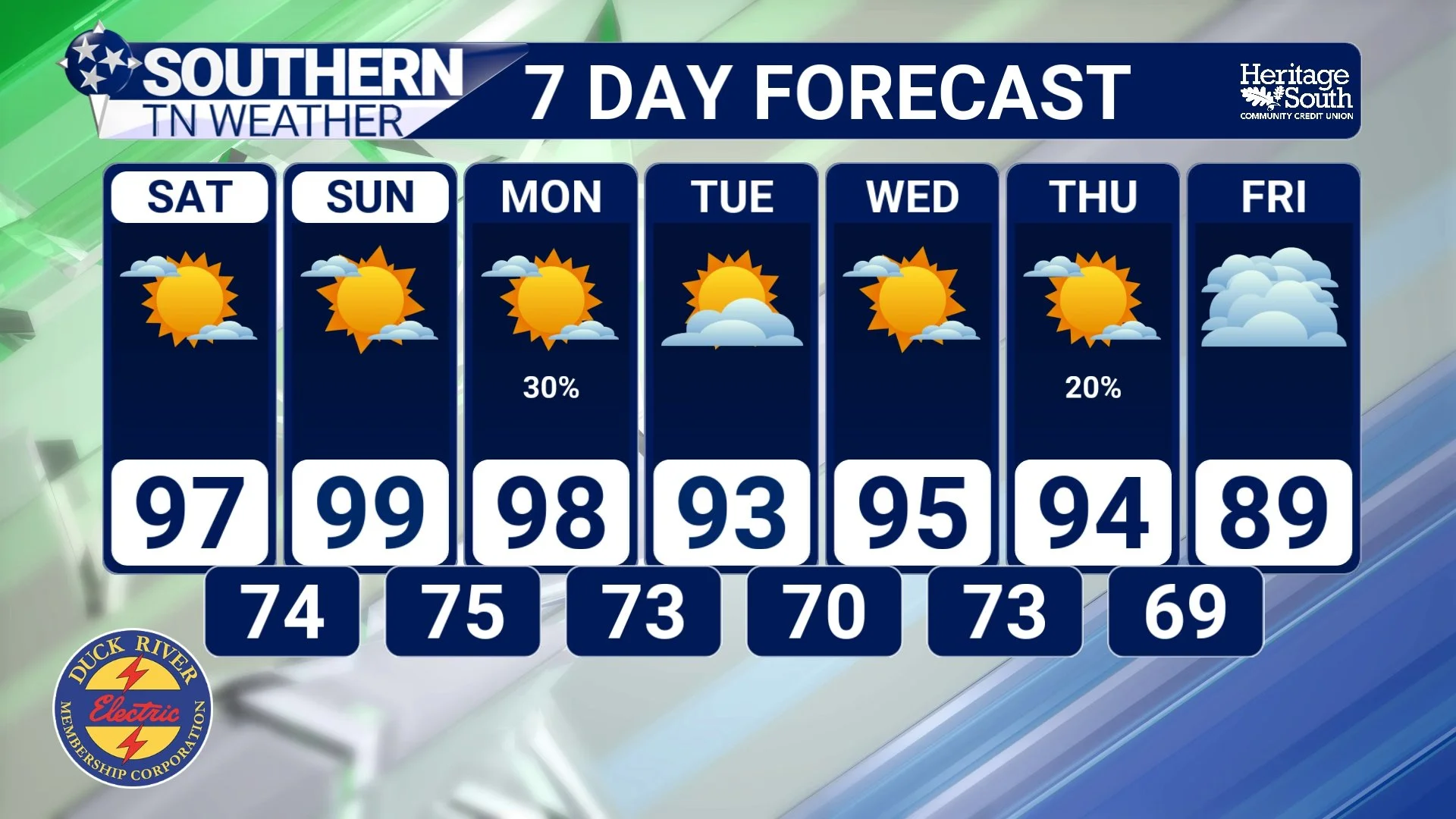
STNWX 7-DAY FORECAST
The Bottom Line 🧾
🌡️ Heat Index: Primarily considers temperature and humidity and is calculated assuming shady, light-wind conditions.
☀️ WBGT: Accounts for temperature, humidity, wind and radiant heat from sunshine, making it especially useful for outdoor activity.
🏈 Who should pay attention? Athletes, coaches, outdoor workers, runners and anyone performing strenuous activity outside.
🔢 Don't compare the numbers directly: A WBGT of 90° does NOT mean the same thing as a Heat Index of 90°.
🥵 This weekend: Highs in the upper 90s to near 100° with Heat Index values of 105–110°+.
🌙 Nights stay hot: Lows only fall into the middle and upper 70s, limiting overnight relief.
⛈️ Rain won't help much: Most communities stay dry this weekend.
📰 Reminder: The Southern Tennessee Weather Blog, presented by Heritage South Community Credit Union, is updated Monday through Friday with fresh, locally tailored forecasts you can trust.
