
Weather Folklore: Heat Lightning

The Southern Tennessee Weather Blog is proudly presented by Heritage South Community Credit Union.
We Help When Others Won’t!
Visit https://www.heritagesouth.org/ today to see how HSCCU can help YOU!
Yesterday we kicked off our new Weather Folklore mini-series by taking a look at one of Tennessee's oldest weather sayings: August fog means winter snow. Today, we're tackling another belief that's probably just as familiar. Have you ever been sitting on the porch during a warm summer evening when you notice flashes of lightning off in the distance—but you never hear any thunder?
Chances are someone nearby has pointed toward the horizon and said, "That's just heat lightning." It's a term that's been used for generations across the South, but does "heat lightning" actually exist? Or is there another explanation? Let's find out.
What Is "Heat Lightning"?
The short answer is... heat lightning isn't actually a special type of lightning. There is no unique form of lightning that only occurs because it's hot outside. Instead, what people call heat lightning is simply ordinary lightning from a thunderstorm that's too far away for the thunder to be heard.
Lightning can easily be seen from 50 to 100 miles away on a clear night, especially if the storm is producing tall thunderstorm clouds. Thunder, however, doesn't travel nearly as far. Under ideal conditions, most people can only hear thunder from about 10 to 15 miles away, although that distance can occasionally stretch a little farther. So if a storm is producing lightning 30, 40, or even 60 miles away, you'll still see the flashes—but the sound never reaches you.
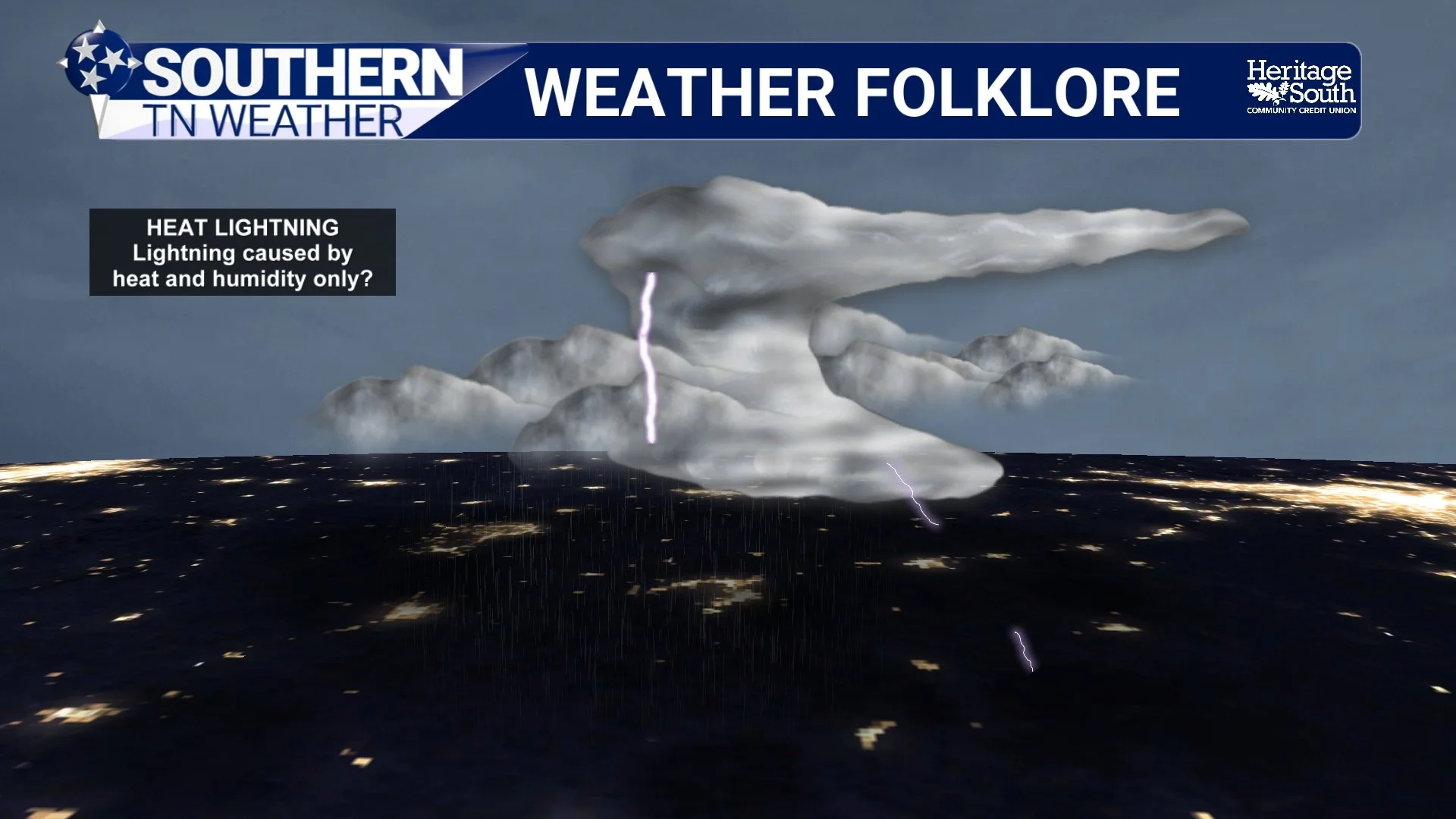
WEATHER FOLKLORE - HEAT LIGHTNING
Why Do People Associate It With Summer?
The folklore actually has a logical explanation. Heat lightning is most commonly noticed during the summer because that's when thunderstorms are most common. Warm, humid evenings also make it much more pleasant to sit outside after sunset, giving people more opportunities to notice distant flashes on the horizon. Nighttime also plays a role.
During the day, sunlight often washes out distant lightning. After dark, however, even storms many counties away can briefly light up the sky. Since these flashes are most often seen on warm summer nights, earlier generations naturally assumed the heat itself was somehow creating the lightning.
Where Did The Name Come From?
The term "heat lightning" dates back hundreds of years and appears in weather records from both Europe and North America. Before scientists understood thunderstorms as well as we do today, many people believed hot, muggy weather somehow produced lightning without rain or thunder. Others thought it was electricity trapped in the atmosphere during periods of intense heat.
As meteorology advanced during the 1800s and 1900s, scientists discovered that wasn't the case. Every lightning flash comes from a thunderstorm. If you're seeing lightning, there's a storm somewhere—you just may not realize how far away it is.
What Does Science Say?
Modern meteorology is very clear on this one. Heat lightning does not exist as a separate weather phenomenon. Every flash of so-called heat lightning is simply ordinary lightning from a distant thunderstorm. One thing worth remembering is that if you can see lightning, the storm may eventually move closer. While it isn't always a safety concern immediately, distant lightning can be an early sign that thunderstorms are approaching.
That's one reason meteorologists often say: "When thunder roars, go indoors." If the lightning gets close enough for you to hear thunder, you're close enough to be struck.
The STN Weather Verdict
Scientific Rating: ❌ Myth. The name has survived for centuries, but the science doesn't support it.
Heat doesn't create lightning, and there isn't a special summertime version of lightning. What people call "heat lightning" is simply regular lightning from a thunderstorm that's too far away for the thunder to be heard. So the next time someone points toward the horizon and says, "That's just heat lightning," you'll know what's really happening.
This Week's Forecast
Speaking of thunderstorms, our weather pattern remains fairly typical for early August. Through Thursday, the best chance for scattered afternoon showers and thunderstorms will remain along and east of Interstate 65, especially near the Cumberland Plateau. Areas farther west will have a much lower chance of seeing rain. No severe weather is expected, although a few storms could produce brief gusty winds, frequent lightning, and heavy downpours before fading around sunset.
Looking ahead to the weekend, afternoon shower and thunderstorm chances continue each day as humidity gradually increases. Temperatures will climb back into the upper 80s and lower 90s, with heat index values reaching the 100 to 105 degree range in many locations. While widespread hazardous weather isn't expected, remember that any summertime thunderstorm can produce dangerous cloud-to-ground lightning.
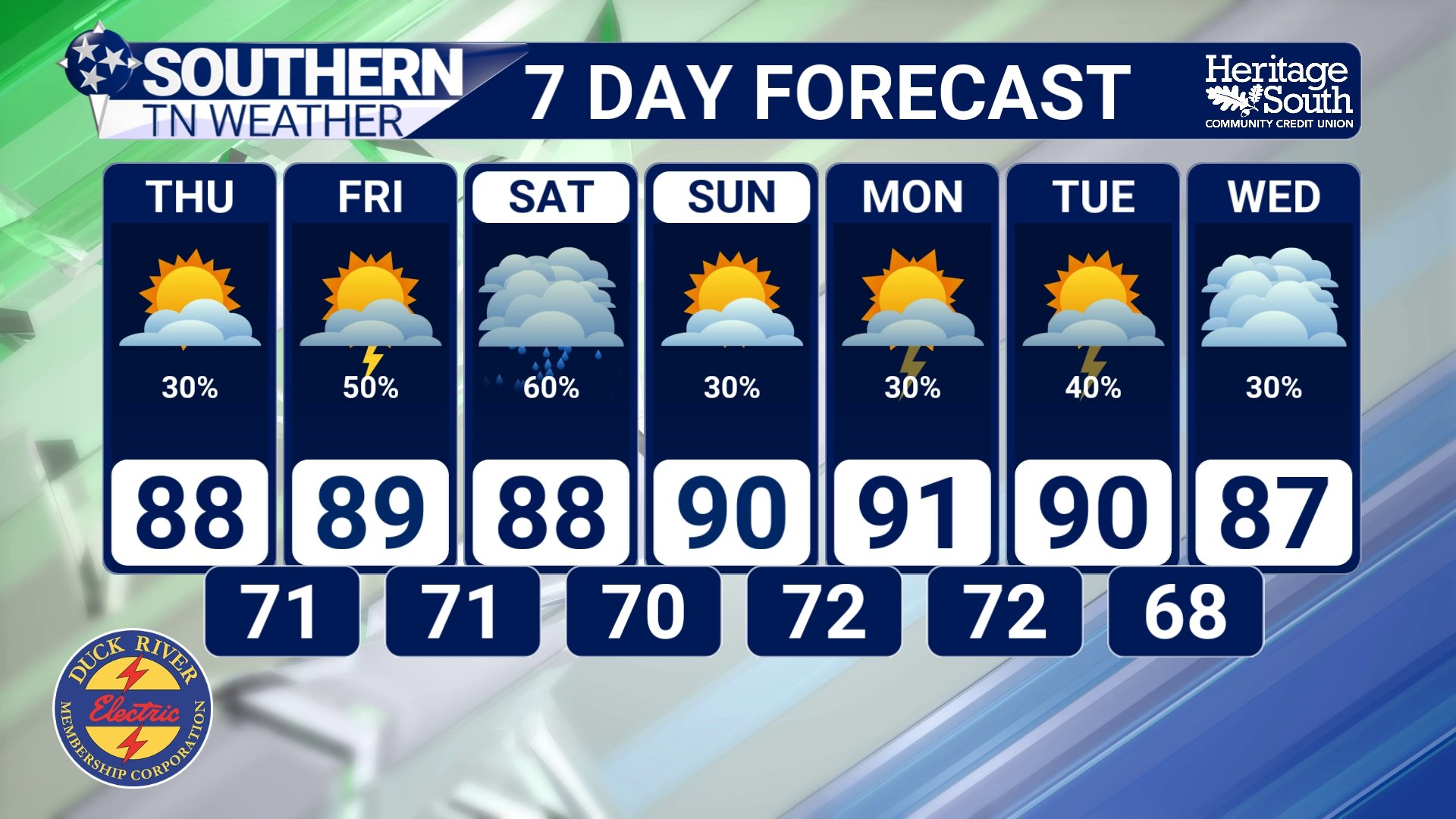
STNWX 7-DAY FORECAST
The Bottom Line 🧾
⚡ Folklore: "Heat lightning" is a special type of lightning caused by hot weather.
📜 Origin: The term dates back centuries, when people believed summer heat itself produced lightning.
🔬 Science: There is no special type of heat lightning. It's simply ordinary lightning from a distant thunderstorm.
❌ STN Weather Rating:Myth
🌦️ Forecast: Typical August weather continues with scattered afternoon storms, mainly along and east of Interstate 65, and gradually increasing heat and humidity heading into the weekend.
📰 Reminder: The Southern Tennessee Weather Blog, presented by Heritage South Community Credit Union, is updated Monday through Friday with fresh, locally tailored forecasts you can trust.
