
Weather Folklore: "Red Skies" at Night and in the Morning

The Southern Tennessee Weather Blog is proudly presented by Heritage South Community Credit Union.
We Help When Others Won’t!
Visit https://www.heritagesouth.org/ today to see how HSCCU can help YOU!
We've all heard them. Those old weather sayings that have been passed down from parents, grandparents, and generations before them. Some have a surprising amount of science behind them, while others are little more than coincidence wrapped in a catchy phrase. That's exactly what this Weather Folklore series is all about.
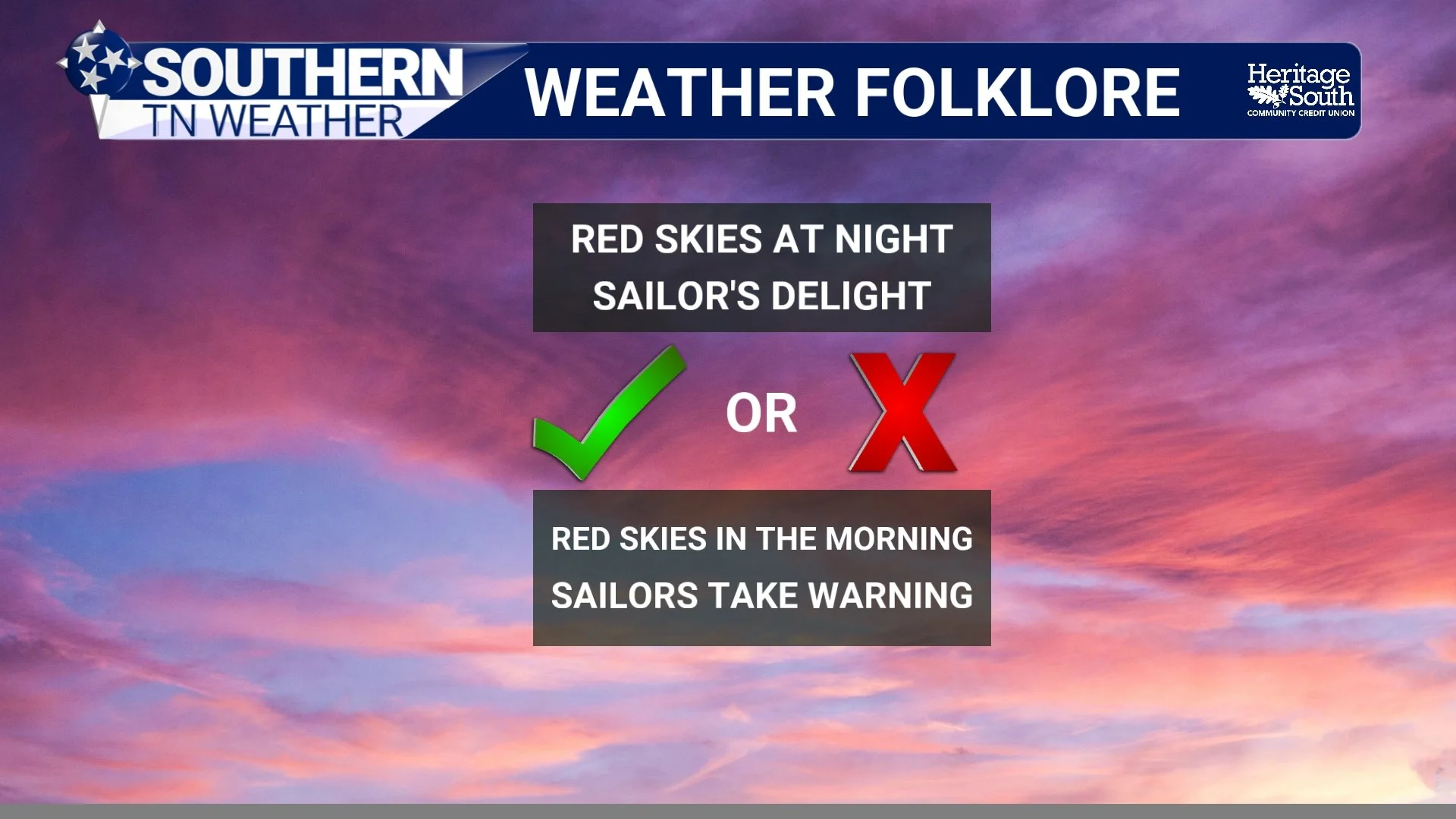
Today's saying is perhaps one of the oldest (and one of the most quoted) weather proverbs in history: "Red sky at night, sailor's delight. Red sky in the morning, sailors take warning."
It's been around for centuries, but does the atmosphere really have a way of warning us with colorful sunrises and sunsets? The answer might surprise you.
Where Did This Saying Come From?
Unlike many weather sayings, this one has a well-documented history. Versions of it date back more than 2,000 years, with similar phrases appearing in ancient Greek writings and even the Bible (Matthew 16:2-3), where Jesus references a red evening sky and a red morning sky while discussing people's ability to interpret the weather.
It later became especially popular among sailors navigating long before modern weather forecasts existed. Out on the open ocean, recognizing subtle changes in the sky could mean the difference between sailing into calm seas or dangerous storms. Over time, the phrase became one of the world's most recognizable pieces of weather folklore.
Why Would the Sky Turn Red?
The science starts with something called Rayleigh scattering. Sunlight is made up of many different colors. As sunlight passes through Earth's atmosphere, shorter wavelengths like blue scatter much more easily than longer wavelengths like red and orange.
When the sun is low on the horizon during sunrise or sunset, its light has to travel through much more of the atmosphere before reaching your eyes. By that point, most of the blue light has scattered away, leaving the reds, oranges, and pinks that paint the sky. So the red color itself doesn't predict the weather. It's what's in the atmosphere that creates those colors that can sometimes tell us something about what's happening nearby.
Why "Red Sky at Night" and “red sky in the morning”?
Across much of the United States (including Tennessee) our weather systems usually move from west to east thanks to the prevailing winds in the middle levels of the atmosphere. If the western sky glows a brilliant red at sunset, it often means the setting sun is shining through dry, stable air to your west. Since that air is generally moving toward us, fair weather is often on the way. That's where the saying... "Red sky at night, sailor's delight" actually has some scientific support.
On the other hand, at sunrise you're looking toward the east. If the eastern sky is glowing bright red, it can sometimes mean the rising sun is shining underneath clouds associated with a weather system that has already moved into your area. Meanwhile, the sun is illuminating moisture and clouds from the west—the direction where our next weather systems often approach. In other words, unsettled weather may be nearby or on the way. That's the reasoning behind... "Red sky in the morning, sailors take warning."
WEATHER FOLKLORE - RED SKIES AT NIGHT AND IN THE MORNING
Does It Actually Work?
Surprisingly... Sometimes, yes. This is one of the few pieces of weather folklore that actually has a legitimate scientific foundation.
However, it isn't foolproof. The saying works best in locations where weather systems generally move from west to east and where skies are open enough to clearly observe sunrise and sunset. It becomes much less reliable in mountainous regions, tropical climates, or when local weather patterns don't follow the typical west-to-east progression. Even here in Tennessee, there are plenty of mornings and evenings where the sky turns brilliant shades of red without any meaningful change in the weather.
The STN Weather Verdict
Scientific Rating: ✅ Mostly True! Unlike many weather sayings, this one is rooted in real atmospheric science. A red sunrise or sunset doesn't cause weather, but under the right conditions it can provide clues about the movement of air masses and approaching weather systems.
It's certainly not as accurate as Doppler radar or modern forecast models—but for sailors centuries ago, it wasn't a bad rule of thumb.
Now, the forecast…
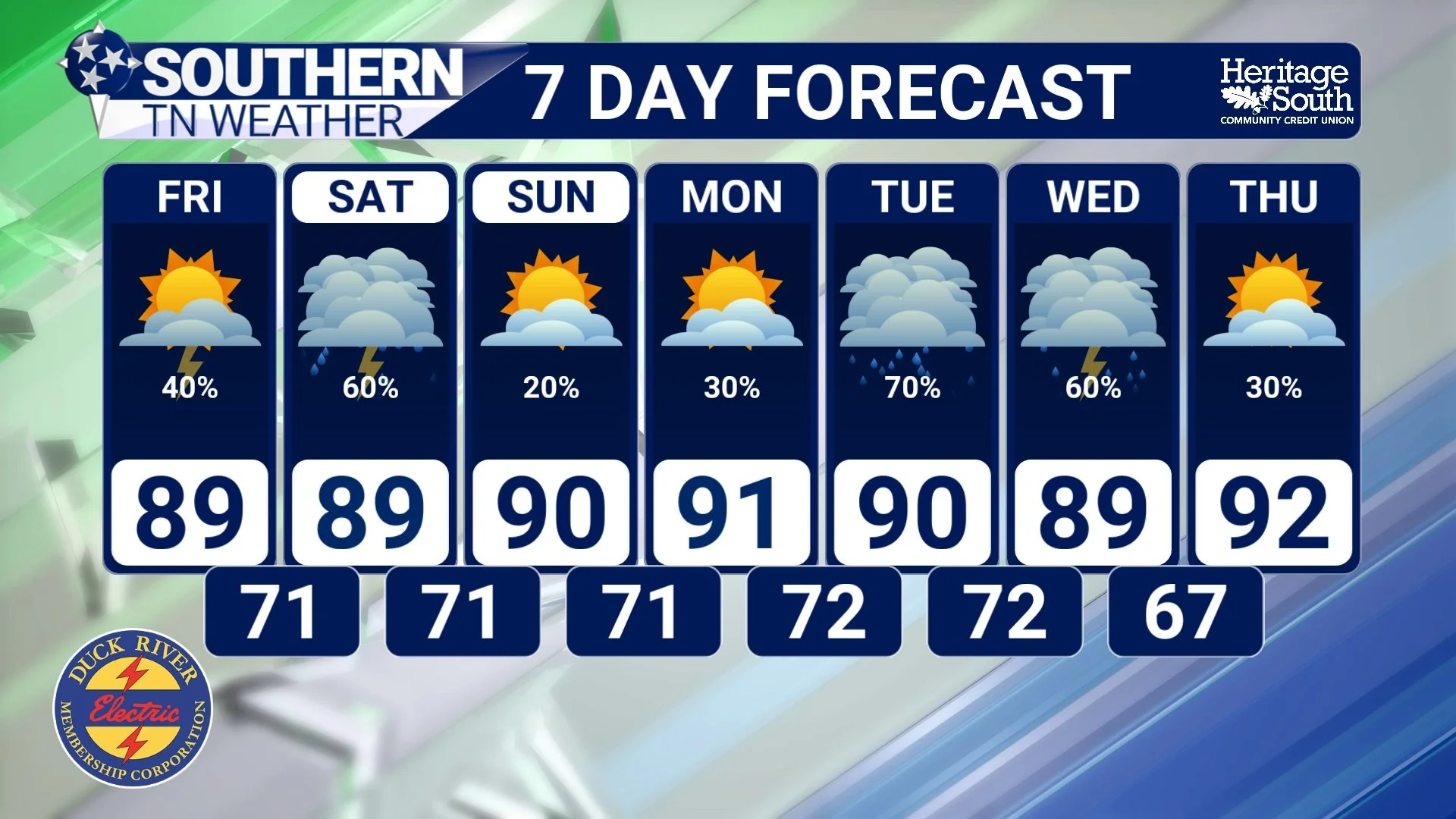
Speaking of colorful skies, we'll continue with a fairly typical August weather pattern through the weekend. Each afternoon will bring at least a chance for scattered showers and thunderstorms, although coverage will remain much higher along and east of Interstate 65 than farther west. Many communities won't receive any rain at all, while others could pick up 2 to 3 inches in less than an hour if a slow-moving storm passes overhead.
Severe weather isn't expected, but a few stronger storms could produce gusty winds around 40 mph, frequent lightning, and localized flash flooding due to torrential rainfall. Temperatures will remain seasonably warm with highs in the upper 80s to lower 90s. Afternoon heat index values will generally climb into the upper 90s and lower 100s, with the hottest stretch expected Sunday through Tuesday as humidity continues to build.
STNWX 7-DAY FORECAST
The Bottom Line 🧾
🌅 Folklore: "Red sky at night, sailor's delight. Red sky in the morning, sailors take warning."
📜 Origin: A weather proverb dating back more than 2,000 years and widely used by sailors before modern forecasting.
🔬 Science: Red skies result from sunlight scattering through the atmosphere. Under the right weather pattern, they can provide clues about approaching air masses.
✅ STN Weather Rating: Mostly True
🌦️ Forecast: Typical August weather continues with scattered afternoon storms, highest along and east of Interstate 65, while heat index values climb back into the upper 90s and lower 100s through the weekend.
📰 Reminder: The Southern Tennessee Weather Blog, presented by Heritage South Community Credit Union, is updated Monday through Friday with fresh, locally tailored forecasts you can trust.
