
A Deep Partial Lunar Eclipse is Coming Thursday Night!

The Southern Tennessee Weather Blog is proudly presented by Heritage South Community Credit Union.
We Help When Others Won’t!
Visit https://www.heritagesouth.org/ today to see how HSCCU can help YOU!
If the weather cooperates Thursday night, we're going to have a pretty cool show in the sky over Southern Middle Tennessee. A deep partial lunar eclipse will occur Thursday night into early Friday morning, and this one is going to come VERY close to being a total lunar eclipse. At its peak, more than 96% of the Moon's surface will be inside Earth's dark central shadow, leaving only a tiny sliver of the Moon directly illuminated by the Sun. NASA confirms the August 27-28 eclipse will be visible across much of the Americas, along with portions of Europe and Africa.
And unlike a solar eclipse, you don't need special glasses. You can safely watch the entire lunar eclipse with your naked eyes. Binoculars or a telescope will simply make the view even better. So, how does all of this work, when should you look outside, and perhaps most importantly for a weather blog... will the clouds cooperate?
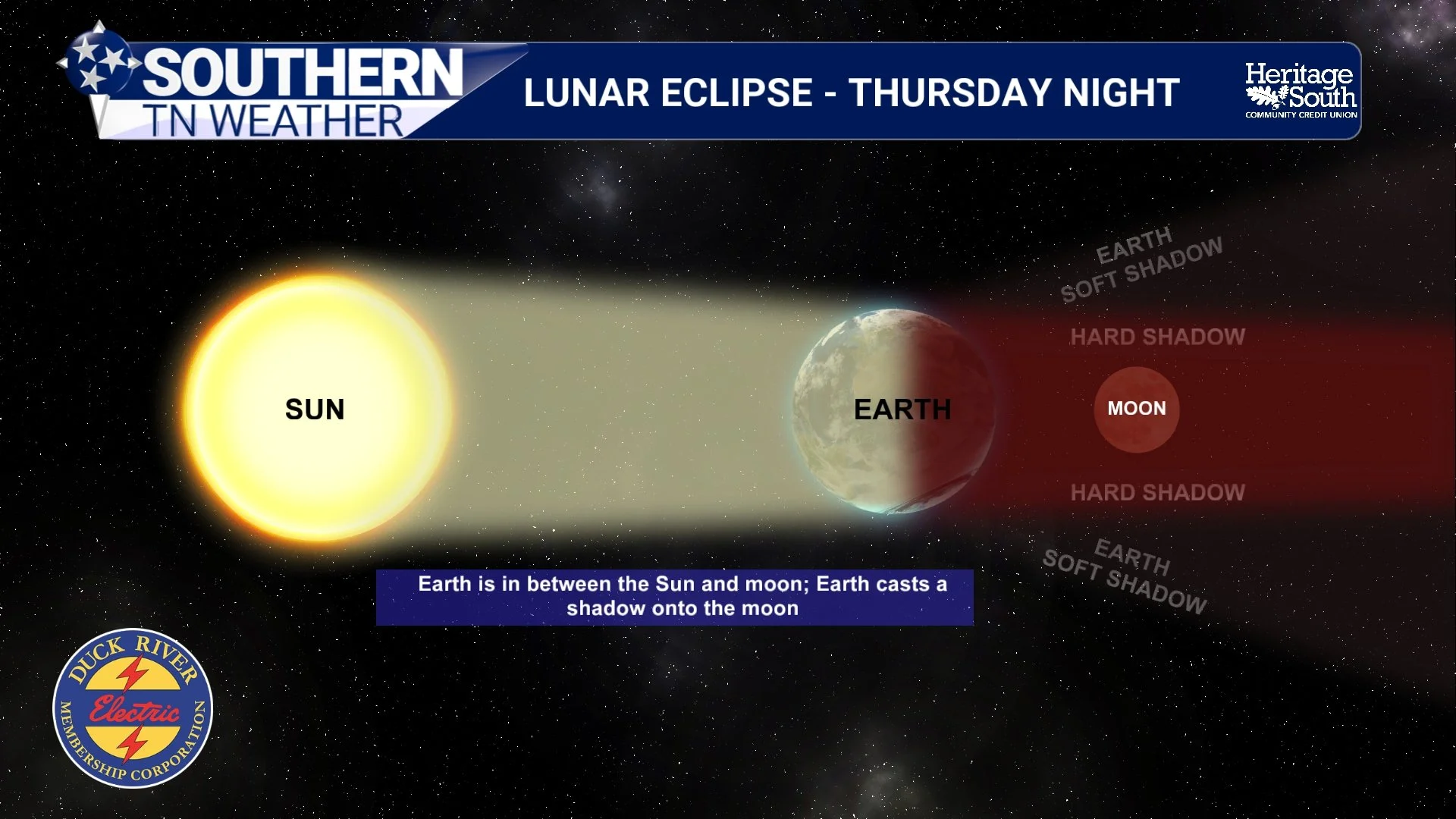
LUNAR ECLIPSE - THURSDAY NIGHT
What Exactly is a Lunar Eclipse?
A lunar eclipse happens when the Sun, Earth and Moon line up with Earth in the middle. Earth blocks the sunlight that would normally illuminate the full Moon and casts its shadow across the lunar surface. But Earth's shadow actually has two main parts. The penumbra is the lighter, outer portion of Earth's shadow. When the Moon moves through it, the lunar surface only dims slightly. In fact, a penumbral eclipse can be subtle enough that you might not notice much happening if you didn't know to look.
The umbra is Earth's much darker central shadow. Once the Moon begins moving into the umbra Thursday night, the eclipse will become dramatically more obvious as Earth's shadow appears to take an increasingly large "bite" out of the Moon. There are three basic varieties of lunar eclipses: penumbral, partial and total. A total eclipse occurs when the entire Moon enters Earth's umbra. A partial eclipse occurs when only part of it does. Thursday night's eclipse is technically partial, but BARELY.
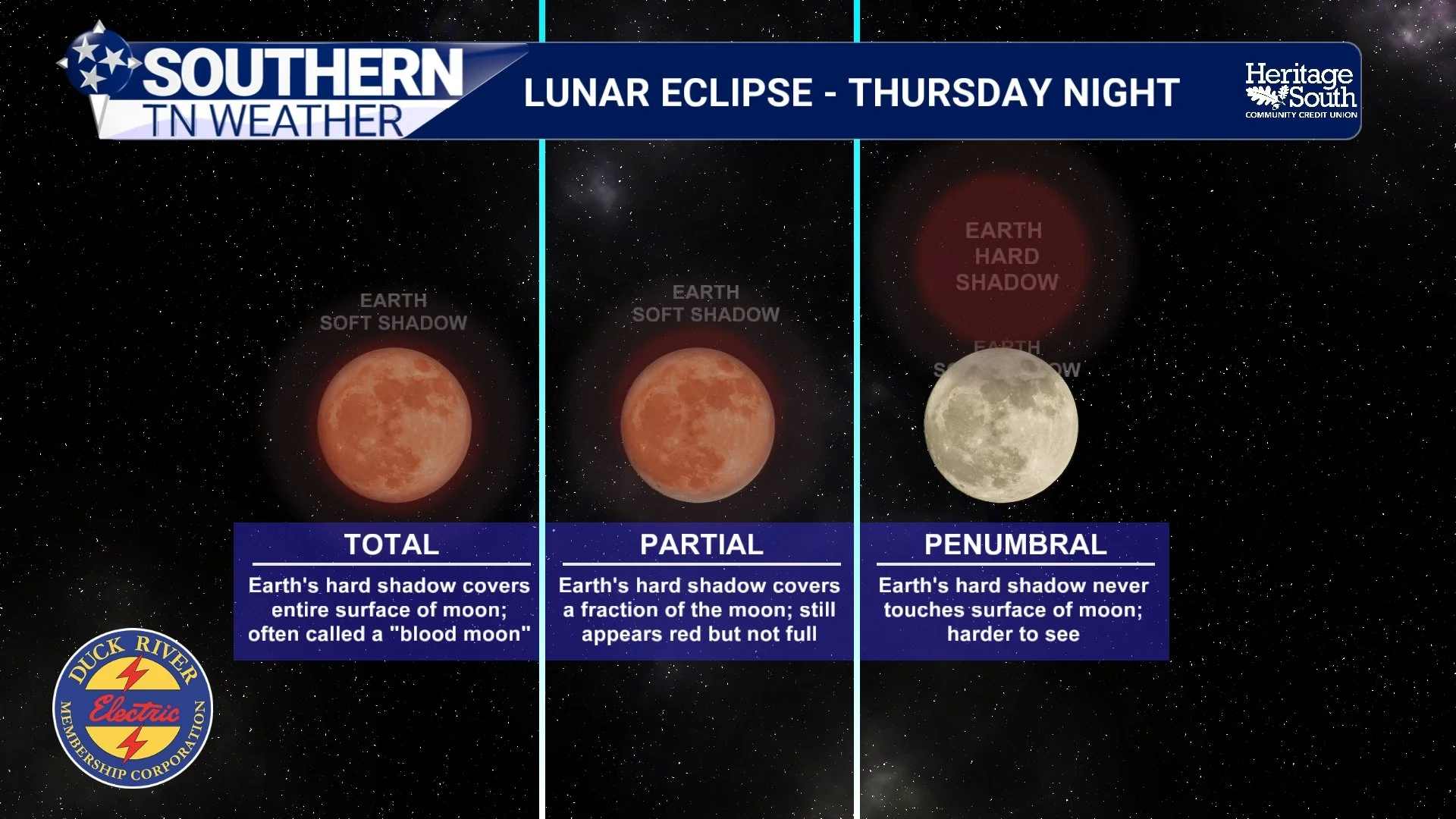
LUNAR ECLIPSE - THURSDAY NIGHT
This One Comes REALLY Close to Totality
At maximum eclipse, NASA calculates that approximately 96.3% of the Moon's disk will be inside Earth's umbra. That means we're missing a total lunar eclipse by only a tiny portion of the Moon. Because such a large percentage will be immersed in Earth's shadow, the eclipse should look considerably more dramatic than your average partial lunar eclipse. Much of the Moon may develop the familiar rusty red or copper appearance commonly associated with a "Blood Moon," while a small portion remains much brighter.
Why red? Even when Earth blocks direct sunlight from reaching the Moon, some sunlight passes through Earth's atmosphere. Our atmosphere scatters shorter blue and violet wavelengths much more efficiently while allowing more red and orange light to continue through. Some of that reddish light is bent toward the Moon and illuminates the portion sitting inside Earth's shadow.
In a way, the reddish Moon is being illuminated by the combined light of sunrises and sunsets occurring around Earth. Pretty cool, huh?
When Should We Look Outside?
For Southern Middle Tennessee, you'll want to start paying attention after dark Thursday evening. The initial penumbral phase begins at approximately 8:23 PM CDT, but don't expect anything spectacular immediately. Remember, the penumbra is Earth's faint outer shadow, so the first changes may be difficult to see. Things get much more interesting beginning around 9:33 PM CDT, when the partial eclipse begins and the Moon starts entering Earth's dark umbra. From there, Earth's shadow will cover an increasingly large portion of the Moon.
The main timeline for Thursday night is:
🌕 8:23 PM: Penumbral eclipse begins
🌘 9:33 PM: Partial eclipse begins
🌗 Around 10:15 PM: Roughly half of the Moon is eclipsed
🌑 11:12-11:13 PM: Maximum eclipse
🌗 Around 12:11 AM Friday: Back to roughly 50%
🌕 12:51-12:52 AM: Partial eclipse ends
🌕 Around 2:01 AM: Penumbral eclipse completely ends
The exact minute can vary slightly depending on location and how the eclipse calculations are rounded But this is a good average for our area. So if you don't want to stay outside for several hours, roughly 10:30 PM through midnight will be the prime viewing window, with the best view around 11:12 PM.
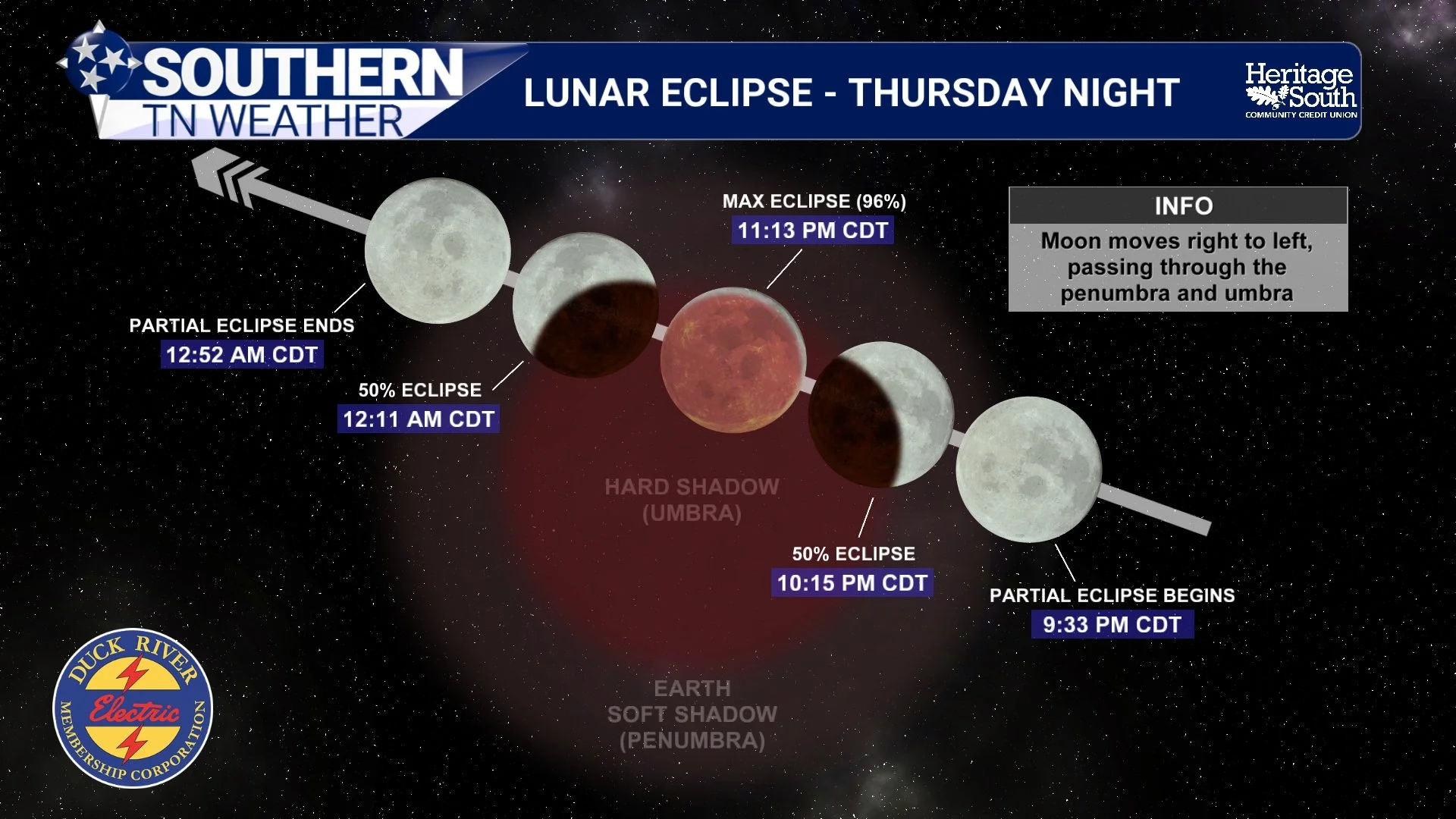
LUNAR ECLIPSE - THURSDAY NIGHT
Where Do I Need to Look?
Fortunately, this isn't one of those astronomical events where I'm going to tell you to find one particular star three degrees above another star while facing northwest and standing on one foot. Just find the Moon. 😂
Around maximum eclipse, the Moon will be roughly 40° above the horizon in the south-southeastern sky, making it relatively easy to see from most locations. You also don't need to escape city lights the way you would for a meteor shower. The Moon is obviously extremely bright, so your backyard, driveway or porch should work perfectly well as long as you have a reasonably unobstructed view of the sky.
And again, NO eclipse glasses are required. Those are necessary for safely observing the Sun during a solar eclipse. A lunar eclipse is simply the Moon passing through Earth's shadow and is completely safe to watch directly.
Now For the Million-Dollar Question... Will We Actually See It?
That's where our weather forecast enters the conversation. Unfortunately, Thursday isn't looking completely cloud-free. A weak cold front will move southward through the region Thursday, bringing another opportunity for scattered showers and thunderstorms, primarily during the afternoon and evening. Rain chances aren't especially high, and this certainly doesn't look like an all-day washout, but scattered thunderstorms could temporarily produce plenty of cloud cover.
The good news is that much of the thunderstorm activity should be diurnally driven, meaning daytime heating helps fuel it. As we lose that heating Thursday evening, storm coverage should gradually decrease. That makes the exact timing of clearing extremely important for eclipse viewing. Right now, I wouldn't cancel your plans to watch it. There is certainly a reasonable opportunity that enough clouds break Thursday night for at least portions of the eclipse to be visible. We'll be able to get much more specific about cloud cover as we get closer.
Before the Eclipse... We're Watching Storms Today
Of course, we've got some weather to get through before Thursday night's show. A cluster of thunderstorms has been moving southeastward across Tennessee this afternoon. The atmosphere contains plenty of instability, but wind shear is weak, which should make it difficult for storms to remain organized for very long. That doesn't mean individual storms can't pack a punch.
Across portions of Southern Middle Tennessee, strong wind gusts, frequent lightning and very heavy rainfall remain possible through this afternoon and evening. The Huntsville forecast office has also noted some concern for localized flooding where storms move repeatedly across the same locations. Storm activity should gradually diminish this evening, generally between about 8 and 10 PM, although patchy fog could develop overnight, particularly in locations receiving rainfall.
Another round of scattered showers and thunderstorms will be possible Thursday as the weak front moves through. Once again, an isolated stronger storm with gusty winds can't be ruled out, but widespread organized severe weather is not expected.
A Nice Weekend Before September Heats Us Back Up
Behind Thursday's front, Friday should turn considerably quieter. A stray shower could linger near the Cumberland Plateau, but most of Southern Middle Tennessee should be dry. The weekend currently looks pretty nice as well. Expect mainly dry conditions with afternoon temperatures generally around the lower 90s west of the Plateau.
Then Mother Nature apparently remembers that summer isn't finished yet. Upper-level ridging is expected to strengthen and shift eastward as we head into next week. That should send temperatures upward again, with highs potentially returning to the middle and upper 90s as September begins. Rain chances also look fairly low overall outside of a small opportunity for an afternoon pop-up storm.
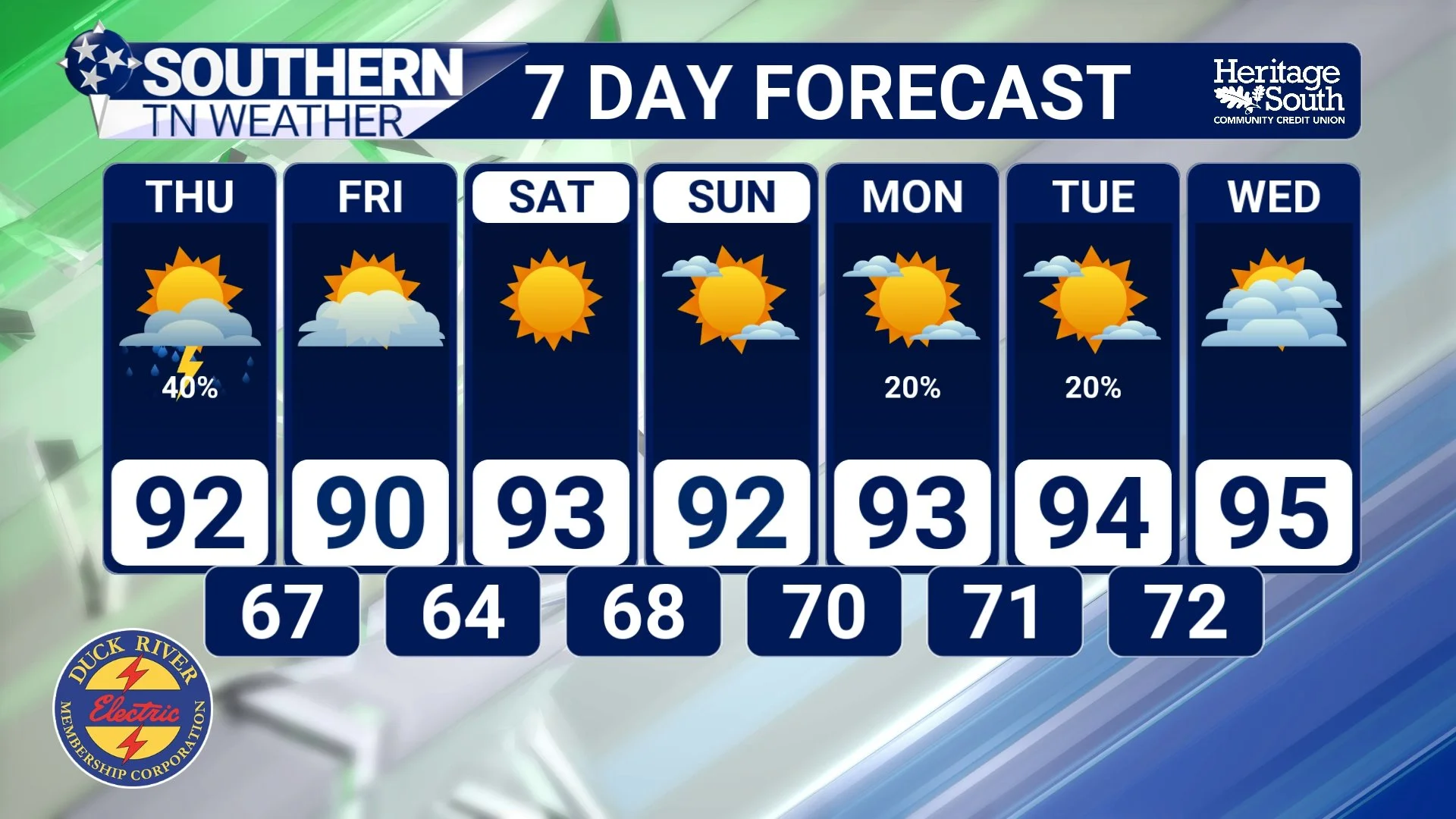
STNWX 7-DAY FORECAST
The Bottom Line 🧾
🌕 Thursday night: A deep partial lunar eclipse will be visible across Southern Middle Tennessee.
🌑 Almost total: Approximately 96% of the Moon will enter Earth's dark central shadow.
⏰ Partial eclipse begins: Around 9:33 PM CDT Thursday.
🔴 Maximum eclipse: Around 11:12-11:13 PM CDT, when nearly the entire Moon will be covered.
🌕 Partial phase ends: Around 12:51-12:52 AM Friday.
👀 No special glasses needed: Lunar eclipses are completely safe to watch with your naked eyes.
☁️ Viewing conditions: Scattered storms and clouds are possible Thursday, but activity should decrease Thursday night. We'll need to watch cloud-cover trends closely.
⛈️ Today: Storms remain possible through this evening with gusty winds, frequent lightning and locally heavy rainfall the main concerns.
🌤️ Weekend: Mainly dry with temperatures around the lower 90s.
🥵 Next week: Above-normal temperatures return, with middle to upper 90s possible as September begins.
So set yourself a reminder for Thursday night around 10:30 PM, cross your fingers that the clouds cooperate, and look up. If Mother Nature plays nice, Southern Middle Tenne
📰 Reminder: The Southern Tennessee Weather Blog, presented by Heritage South Community Credit Union, is updated Monday through Friday with fresh, locally tailored forecasts you can trust.
