
Weather Folklore: Can a Persimmon Seed Predict Winter?

The Southern Tennessee Weather Blog is proudly presented by Heritage South Community Credit Union.
We Help When Others Won’t!
Visit https://www.heritagesouth.org/ today to see how HSCCU can help YOU!
We're going from sunshowers to something a little more seasonal in today's edition of Weather Folklore. And considering we're currently sweating through heat index values above 100 degrees, talking about snow and bitter cold honestly doesn't sound half bad. 😂 Today's folklore involves a fruit you can find growing wild across much of our region: the persimmon.
According to an old Appalachian and Ozark tradition, you can crack open the seed of a locally grown persimmon and find a tiny shape inside that supposedly reveals what Mother Nature has planned for the upcoming winter.
🥄 Spoon = A snowy winter
🔪 Knife = A bitterly cold winter with "cutting" winds
🍴 Fork = A mild winter
It's one of the more creative winter forecasting methods out there. But can a tiny seed growing inside a piece of fruit in August and September really know what the atmosphere is going to do in January?
Where Did the Persimmon Seed Tradition Come From?
The exact beginning of this tradition is difficult to pin down, but persimmon forecasting has deep roots in Appalachian and Ozark weather folklore. Long before Doppler radar, satellites, computer models, and seven-day forecasts, people depended heavily on observations of nature to anticipate changing seasons. Plants and animals became especially popular forecasting tools.
People watched woolly worms, squirrels gathering nuts, the thickness of corn husks, the abundance of acorns, and dozens of other supposed signs of the winter ahead. Eventually, the persimmon seed joined the list. And there's actually a clever little memory trick behind each prediction.
A spoon means you'll need a shovel for all the snow. A knife means bitter winds will "cut" right through you. And a fork supposedly means an easier, milder winter. I'll give our ancestors this much—they certainly knew how to make a weather forecast memorable.
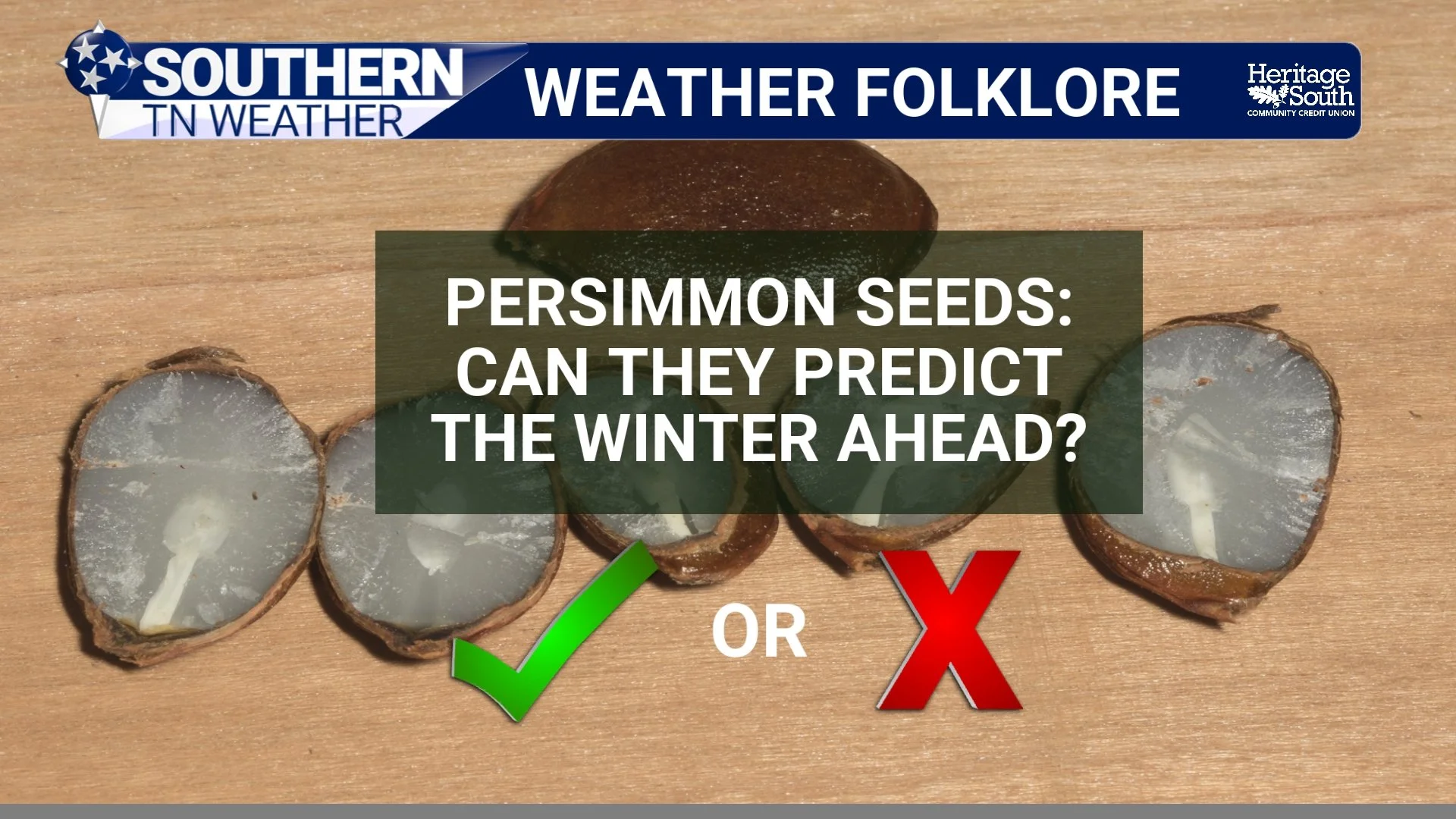
STNWX - TUESDAY FOLKLORE
What's Actually Inside the Seed?
Here's where we need to clear up one misconception. The persimmon isn't literally growing a miniature spoon, fork, or knife. What you're looking at is part of the developing plant embryo inside the seed. Depending on how it's shaped and how the seed is sliced open, that structure can resemble one of the three pieces of silverware. For the folklore to "work," tradition also says you should use a locally grown American persimmon, rather than one shipped in from somewhere else.
But there's one fairly significant problem… There's no known biological mechanism that would allow a persimmon seed to know what the atmosphere will be doing several months later.
Can a Persimmon Know What Winter Will Bring?
Nope. The type of winter we experience across Southern Middle Tennessee depends on enormous atmospheric and oceanic patterns unfolding across the planet. The position and strength of the jet stream matters. So do Arctic air masses, storm tracks, ocean temperatures, blocking patterns, the polar vortex, and large-scale climate patterns such as El Niño and La Niña.
And even when meteorologists know the state of those larger climate patterns, predicting snowfall months ahead remains extremely difficult. A persimmon growing alongside the road in Bedford County doesn't have access to that information. Apparently nobody gave it the Wi-Fi password!
Our Climate Data Makes This Even More Obvious
One of the biggest problems with trying to predict a "snowy winter" around here is just how wildly our snowfall can vary from year to year. Take nearby Huntsville as an example. Based on current 1991–2020 climate normals, Huntsville averages only about 2.4 inches of snow during an entire year. But that average doesn't mean every winter produces somewhere around two inches. Not even close.
Huntsville's snowiest season on record, 1963–64, produced 24.1 inches of snow—roughly TEN TIMES the current annual normal. And there have been plenty of winters on the opposite end of the spectrum with very little measurable snowfall. That's pretty typical of our part of the country.
Southern Middle Tennessee sits in a transition zone where tiny changes in storm track and temperature can make an enormous difference. A winter storm tracking 50 miles one direction might bring us several inches of snow. Move it 50 miles the other direction and we're standing outside in 38-degree rain wondering what could've been.
Why Does This Folklore Seem to Work Sometimes?
This comes back to something we've discussed several times during this series. Eventually, you're going to get one right. There are only three choices: snowy, cold, or mild. Crack open enough persimmons over enough years and eventually you'll find a spoon before a snowy winter, a knife before a bitterly cold one, or a fork before a mild one. And those are the years people remember.
Nobody is posting pictures in February saying: "UPDATE: The persimmon lied to us." 😂
There's another problem, too. What exactly qualifies as a snowy winter? Five inches might be a big winter in Southern Middle Tennessee but practically nothing somewhere like Michigan. Without clearly defined thresholds, it's extremely easy to declare the folklore correct after the fact.
The STN Weather Verdict
Scientific Rating: ❌ False — But It's a Fun Tradition! This one doesn't have the small scientific connection we've found with a few other pieces of folklore. There's simply no evidence that the shape inside a persimmon seed can predict snowfall, temperatures, wind, or the overall character of the upcoming winter.
Even sources that explain how to perform the persimmon test acknowledge that it's an unscientific way of predicting winter weather. But I'm not saying you shouldn't crack one open this fall. Weather folklore is part of our history, particularly here in the South and Appalachians. Traditions like this are fun precisely because they've been handed down through generations. Just don't go buy a snowblower because your persimmon had a spoon in it.
A Quick Look at the Forecast
We certainly don't need to worry about spoons, snow shovels, or bitter winter winds anytime soon. 🥵 Dangerous heat will be the biggest weather story across Southern Middle Tennessee through the remainder of this week and into the weekend. Afternoon highs will climb into the middle 90s today and Wednesday, with heat index values reaching the low 100s. By Thursday through Saturday, many communities west of the Cumberland Plateau could reach the upper 90s, with heat index values of 105 degrees or higher becoming increasingly likely. And unfortunately, the nights won't provide much relief. Overnight lows will remain in the middle and upper 70s with plenty of humidity hanging around.
We do have low to medium chances for thunderstorms this afternoon and again Wednesday, particularly along and east of Interstate 65. There's quite a bit of uncertainty surrounding exactly how much storm activity we'll see, but any stronger storms that manage to develop could produce damaging wind gusts and very heavy rainfall. As high pressure strengthens later this week, storm chances will decrease even further. That also means fewer clouds and fewer rain-cooled afternoons.
By the weekend, we're watching the possibility of actual temperatures approaching the upper 90s to around 100 degrees in some locations. The heat should finally begin easing somewhat early next week as the ridge shifts west and rain chances start increasing again.
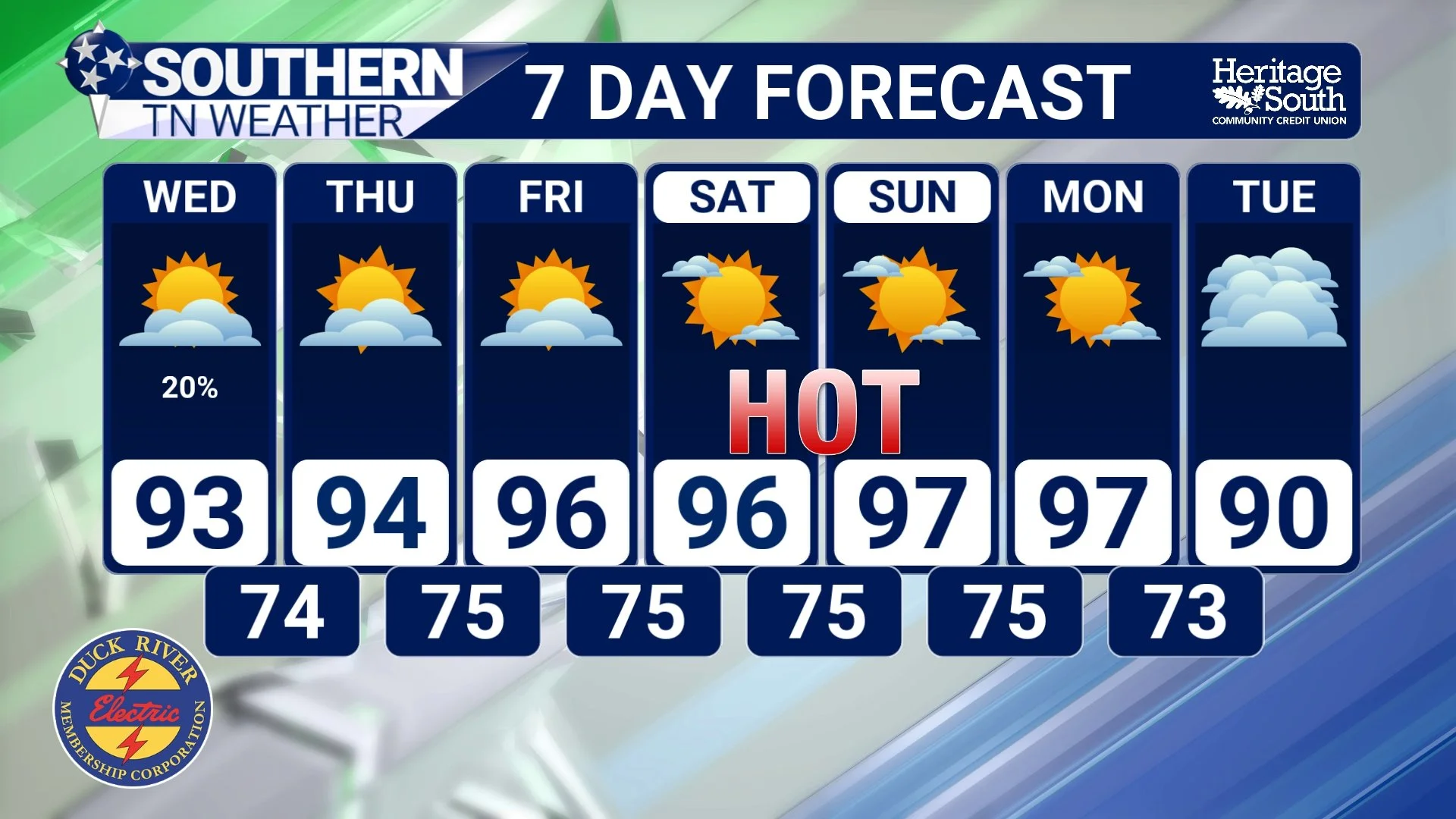
STNWX 7-DAY FORECAST
The Bottom Line 🧾
🥄 Spoon: Folklore says prepare for lots of snow.
🔪 Knife: Supposedly means bitter cold and cutting winter winds.
🍴 Fork: Supposedly points toward a mild winter.
🌳 Origin: A long-standing tradition associated especially with Appalachian and Ozark weather folklore.
📊 Climate Reality: Winter snowfall varies tremendously from year to year across our region and depends on atmospheric patterns that develop thousands of miles away.
❌ STN Weather Rating:False — but a fun Southern tradition.
🥵 Forecast: Dangerous heat builds through the weekend, with heat indices routinely reaching triple digits and potentially exceeding 105 degrees later this week.
📰 Reminder: The Southern Tennessee Weather Blog, presented by Heritage South Community Credit Union, is updated Monday through Friday with fresh, locally tailored forecasts you can trust.
